
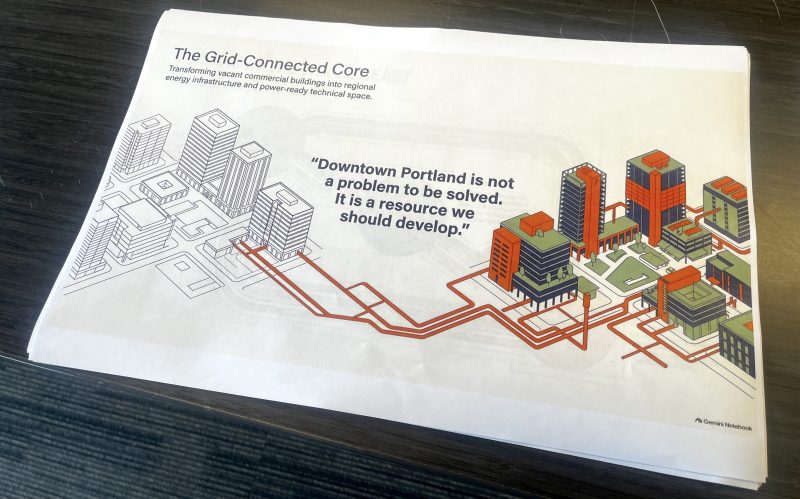
Downtown Portland is not just a problem to be solved. It is, in fact, a resource we should develop.
Starting in 2028, downtown Portland buildings must begin complying with Oregon’s new Building Performance Standard. And the Northwest region itself needs far more electrical capacity than it currently has, as the draft Ninth Power Plan makes clear.
These three issues: the Building Performance Standard, the NW’s energy system’s need for more capacity, and downtown Portland’s need for reinvention, have a common and connected solution.
Behind the locked doors of downtown Portland are empty buildings with already built grid connections and idle electrical capacity. We know that new high-capacity connections can take years to build. Downtown’s are already there.
There will be a compliance cost that each building owner will face by themselves. The Grid-Connected Core concept proposes that we think of downtown no longer as each building as an island unto itself, but in the aggregate, as energy infrastructure. Creating power-ready, and purpose-built, technical space for companies that cannot find it elsewhere means years of work for Portland’s trades, and a transformation that brings new employers and activity downtown.
The building owners will be required to, subject to negotiations, have storefronts that will have reduced rents or flexible terms in order to help build out the those retail or service businesses that are necessary to serve the district and increase the vibrancy of downtown. This is called the Ground Floor Guarantee.
This new Grid-Connected Core combines three functions:
1. Regional energy infrastructure, as the “buildings become batteries” and thus conserve, store, manage and dispatch electricity as a virtual power plant.
2. Modernized upper floors become a plug-in power district for companies that cannot wait years for electrical capacity.
3. A ground-floor economic/retail hub that serves the public. Participating buildings provide a five-year Ground Floor Guarantee for uses that restore foot traffic and activity to downtown streets. Those upper floor businesses need places to eat and shop!
Oregon’s current industrial policy is geared toward large manufacturing projects that need acres of land and enormous capital. That industrial policy should now include a downtown Portland that will serve smaller technical companies who are constrained by power, not land.
The Planning Commission’s Recommendations
I built out the Grid-Connected Core around the idea that downtown’s vacant commercial buildings could house smaller technical businesses. Then, independently, in the Planning Commission’s newly released recommendations for zoning, code, and design, a crucial provision was proposed: Section 33.510.125.
This recommendation allows for Manufacturing and Production uses in Central City CX buildings. Its examples, like R&D, specialized small-scale production, and 3-D printing, are exactly the kind of occupants I envisioned for the Grid.
So – The City’s Planning Commission is now recommending the exact downtown economy I am proposing to achieve with the Grid-Connected Core.
Portland should compete internationally
Very important also: There are issues of world-wide importance that, when looked at closely, can be seen as interconnected, related to energy, climate, and technology.
The global tech economy has been in a race to slip the constraints of the acreage it needs for hardware and data. More and more, though, there is a new, dire, constraint: time to power. Connecting a major new electrical load in many tech markets can take three to seven years, and that is leaving companies with nowhere, and no way, to grow. The Grid-Connected Core can solve for that.
Portland should compete internationally for those companies that are too technically demanding for ordinary offices, and are hitting a wall on time to power.
Washington County manufactures the chips; Portland can manufacture the companies.
How do we start up this start-up? FAST
Portland should invite the National Science Foundation’s Frontiers of Advanced Semiconductor Technology Engine (FAST) to become the anchor tenant in the first Grid-Connected Core building. FAST is an Oregon consortium that includes nearly 100 partners from across Oregon. FAST can also receive up to $160 million to grow the state’s semiconductor ecosystem if it meets NSF milestones; it will initially receive a $15 million grant over two years. Its ambitious goals include launching 180 start-ups in those 10 years.
What Portland—and the Grid-Connected Core—can offer FAST is the ability for FAST to spend its grant money on research, equipment, training and incubating start-ups, not real estate, power, or technical infrastructure.
A FAST Portland building would be where those start-ups take off. It could be the landing spot for newly formed businesses, researchers and students from OSU and PSU, or teams from established companies working with the universities on technical problems, as Lam Research is now doing with OSU. The goal with a FAST pipeline is to create an Origin Core: the first building where FAST startups, university researchers and established companies work together, that can grow into a district that welcomes businesses from around the world and provides them with not just the technical infrastructure that they need, but also the creativity and lifestyle that Portland and the NW is justifiably known for. As companies in the Origin Core grow, or other companies spin off, there should be no question that they will continue to call downtown Portland home.
THE GRID-CONNECTED CORE MEANS COORDINATION
One of the major inversions of this undertaking is to stop thinking of each building as an isolated island, and instead as part of an ecosystem that each building, business, and vendor belongs to and is made stronger and more resilient by. The Core plan will bring coordination and economies of scale to the work that will be required to meet the new standards, thus allowing the participating building owners to take advantage of an aggregated purchasing and vendor strategy, lowering their individual costs.
Portland will also help coordinate financing through PropertyFit financing as well as PCEF, Energy Trust and state and federal programs for the energy and climate work, for at its heart, this is a massive, groundbreaking climate resiliency project. It will reduce energy consumption. It turns buildings into batteries for energy storage. It will support the grid during heat waves, and shift demand when that is necessary. It will also likely reduce pressure for fossil-fuel or new greenfield energy infrastructure projects. An important point, also, is the General Fund will not be considered as a main source of any funding. The district will be the stronger for it, and hopefully will find creative and durable ways to pay that will only add to the General Fund.
Coordination has already been identified by PGE as a useful concept. They’ve shown that when batteries and flexible loads are not spread or scattered, but are more concentrated, it helps the local grid.
They already pay commercial customers to reduce demand and make batteries available so an agreement between owners and the grid could earmark some percentage of those payments to repay PCEF loans, or if PGE identifies that there is additional value to coordination, then a district-wide arrangement might make sense. PCEF could then use the repayments to help finance the next group of buildings. This creates a business flywheel based on cooperation and resiliency. That’s what Portland could and should be known for.
THE EXCHANGE
Portland, through the Grid-Connected Core, is providing public investment, scale, marketing and coordination. But even more, Portland is providing a solution to what has seemed like an unsolvable problem, for Portland, and for downtown businesses. I’ve spent a lot of time on that part of the equation, and now here’s the other.
Participating owners will place designated storefronts into the five-year Ground-Floor Guarantee program, and offer reduced rents or other flexible terms, and help build out these ground floor businesses. These obligations of course will have to be negotiated and specified over time as the Core develops. This guarantee will remain if the building is sold. That is the exchange, and that is why this is not simply a hand-out to business owners. They are partners in the reinvention.
Demand, of course, drives the economic viability of converting buildings to living spaces. This would make housing near these businesses more desirable, and should make the conversions needed more economically viable.
THE BEGINNING
There are so many moving parts to this idea, but it needs to start as all great projects do, with the people. PGE and PPL to help identify buildings and measure capacity. FAST who we hope can be a founding partner. And not least, nor last, reaching out and initiating talks with business owners and Portland’s business associations.
THE RESULT
Any strategies or incentives that have tried to address the fact that downtown Portland is struggling seem to only focus on trying to bring back 2019. “If only we can find enough businesses that will fill up these buildings so that we can charge them rent”. That hasn’t worked, and the Grid-Connected Core is, if nothing else, not more of the same. It contains the seeds to establish a new role for Portland in Oregon’s industrial future. It turns downtown into regional energy infrastructure, then uses that infrastructure to offer new companies speed to power, somewhere to grow, and customers for the businesses below. A durable flywheel is created.
The individual pieces of this plan, for the most part, already exist. But integrating them in this way is a reinvention of urban development strategies.
Isn’t Portland due for a reinvention?


2 responses to “A New Economic Vision for Portland”
[…] many startups cannot get power, literally, quickly enough to grow. We are sitting on a solution. My Grid-Connected Core initiative will turn Portland’s underutilized, grid-connected downtown into a plug-in power […]
[…] So – The City’s Planning Commission is now recommending the exact downtown economy I am proposing to achieve with the Grid-Connected Core. That’s a step closer to achieving the Downtown Renaissance that I can see. Read the whole plan here […]